Security operations
Making better decisions during uncertainty: how security teams act amid conflicting signals
Most security teams don’t struggle with a lack of signals. They struggle with deciding what’s credible enough to act on before it’s too late. In fast-moving disruptions, early reports rarely present a clear or complete picture as sources vary in credibility, and new information rewrites what teams thought they understood only minutes earlier.
Because of that, waiting for certainty can feel like the responsible move.
But in reality, it’s often where risk begins to increase.
For security teams, that creates a demanding operating environment: managing disruption when the picture is still forming.
Signals may already be visible, but the real work lies in deciding which ones are credible enough to support action. That has become harder as misinformation and disinformation have become a more persistent part of the risk landscape. In the World Economic Forum’s Global Risks Report, misinformation and disinformation ranked among the top two short-term global risks for the third consecutive year.
In those conditions, teams still need to judge which signals are credible, relevant, and urgent enough to act on while the situation is still evolving.
Why waiting feels responsible but actually creates risk
When the situation is still uncertain, waiting can feel like the sensible move. No one wants to escalate based on a rumor or brief leadership on something that turns out to be wrong.
But in fast-moving disruption, waiting is not neutral. It is still a decision, and it often increases risk in its own way.
The difference is not minutes. It is options.
A route change becomes a traveler already in transit.
A precaution becomes an incident response.
A leadership brief becomes an explanation after the fact.
The organization does not pause while security teams work toward certainty. As such, exposure continues to evolve, whether the picture is clear or not.
That is why delay creates risk. The longer teams wait for certainty, the more their best options start to disappear. What could have been a route change becomes a traveler already in motion. What could have been an early warning becomes a response after the fact.
That is why certainty is the wrong benchmark. Certainty is a lagging indicator. What matters is having enough confidence, early enough, to make a sound decision that still has value.
Certainty comes after reports align and facts stabilize. Confidence comes from having enough verified, contextualized information early enough to make a sound decision while it still matters.
Acting confidently amid uncertainty
This is where strong security teams set themselves apart.
Acting confidently in an uncertain situation is not about reacting to every signal or trying to be first for the sake of it. It is about moving from early awareness to informed action before the window to respond starts to close.
It is what we call the messy middle of disruption: the period between the first signal and a clear understanding, when reports are fragmented, facts are still shifting, and the organization is still exposed. It is where security teams are under the most pressure, because waiting for certainty can cost time, but acting too quickly on the wrong information can create problems of its own.
Samdesk is built for that middle ground. It continuously builds a single, evolving view of an incident, verifies what is credible, and connects emerging events to the people, assets, and operations that may be affected. Instead of forcing teams to reconcile conflicting reports manually, it reduces noise, clarifies what matters, and helps teams act with confidence before the picture is complete.
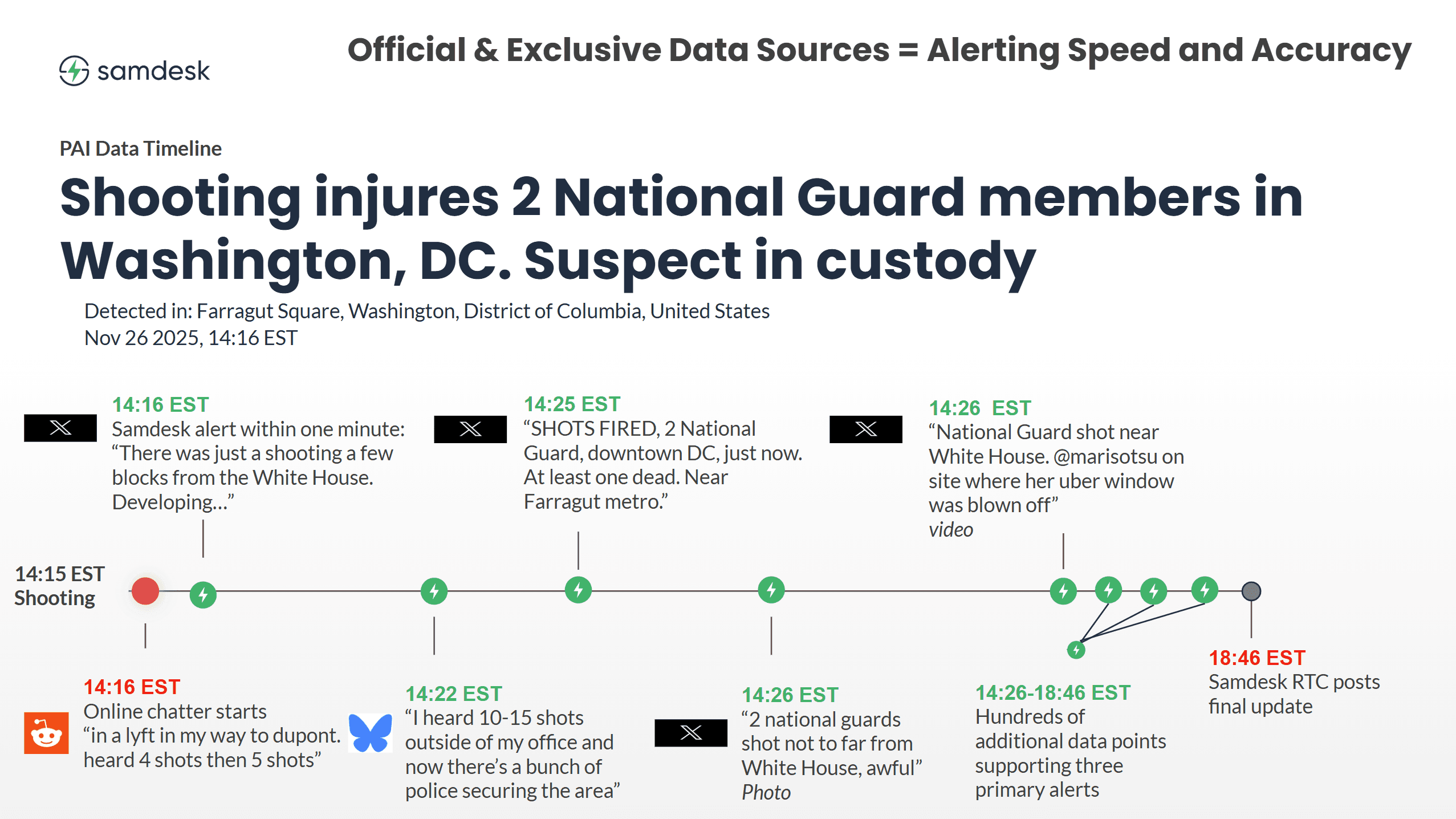
In one example, following a shooting near the White House involving National Guard members, early public reporting was chaotic and contradictory. Samdesk detected the first credible signals within one minute of the incident and continued to process and verify new information over the next four hours, refining the picture as details emerged and ultimately confirming the outcome: two guards injured, suspect in custody.
For organizations with people or operations in the Washington, DC area, that early verified signal gave created immediate clarity. Teams were not waiting for the situation to stabilize. They had enough confidence to assess exposure, brief leadership, and decide what to do next while the incident was still unfolding.
Early, verified information does more than inform. It creates options. And in fast-moving disruption, better decisions are not made by those who wait the longest.
They are made by those who understand enough, early enough, that they can respond in proportion to the situation, even amid uncertainty.